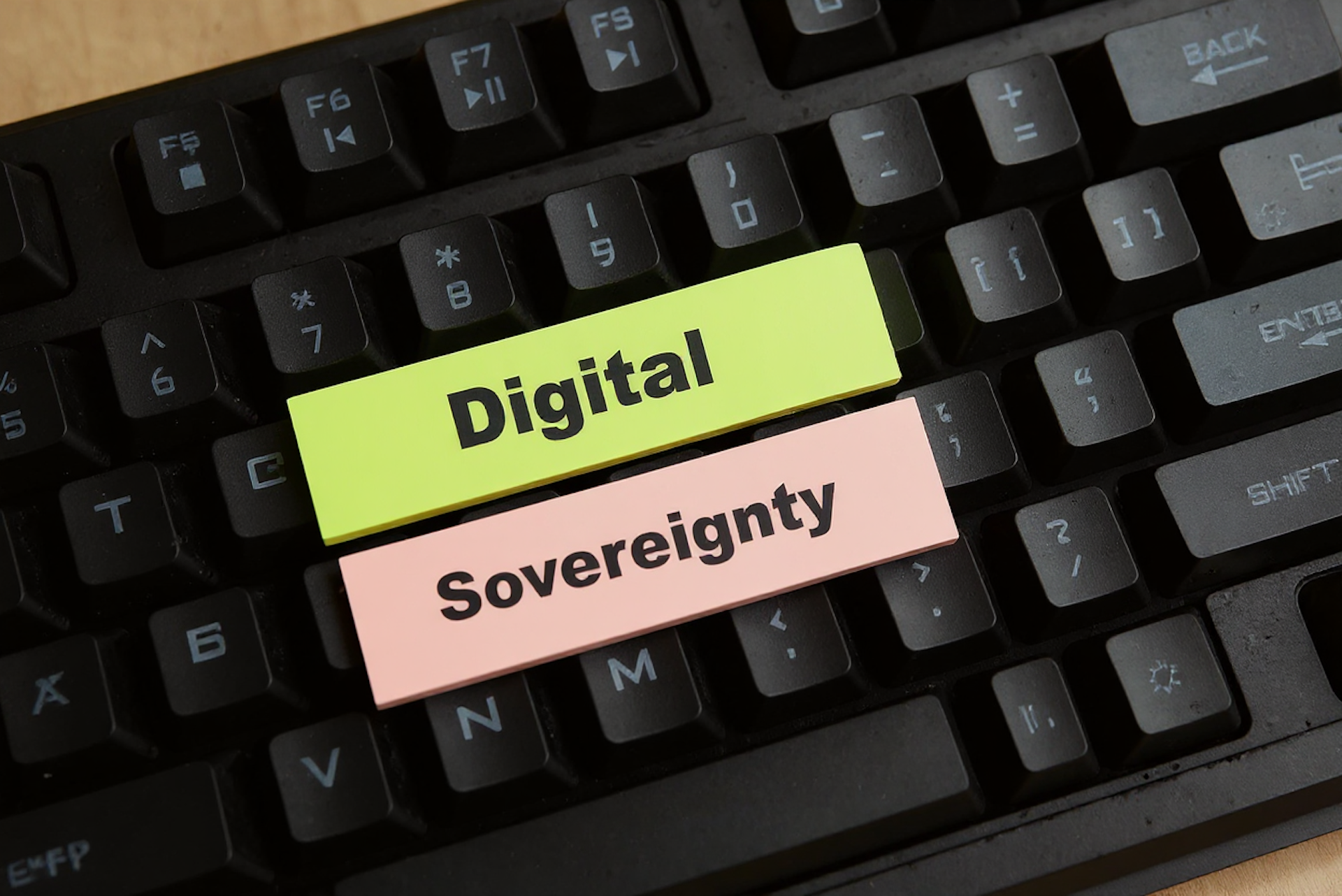
Digital sovereignty: How do you make it work without locking down your organization?
17 February 2026
Digital sovereignty is appearing on the agenda of more and more organizations. Sometimes due to new legislation or geopolitical developments, but increasingly because of a growing sense of discomfort: do we still truly have control over our data and systems?
The difficulty is that the topic quickly becomes abstract. Discussions often shift to extremes: everything European and fully self-managed, or everything in the cloud with one major provider. But such black-and-white choices rarely solve the real issue. The question is not whether sovereignty is important, but how to organize it in a way that remains workable without slowing down innovation.
Digital sovereignty is not a purely technical issue, but primarily a strategic one. It is about control, risk, and dependencies. Technology follows those choices, not the other way around. Those who start with tooling risk building a solution for a problem that has not yet been clearly defined.
A workable approach therefore begins with a different question: what does sovereignty mean for our organization? Is it about the location of data? Access by foreign parties? Legislation outside the EU? Or dependency on a single supplier? In most cases, it quickly becomes clear that not all data and systems carry the same risk profile. That nuance creates room for balanced decisions.
By distinguishing between different types of data and applications, space emerges. Some data is critical or sensitive and requires maximum control. Other data is primarily operational or replaceable and can be hosted with managed risk. By applying this nuance, you prevent sovereignty from unnecessarily hindering innovation or speed. At the same time, you prevent speed from unintentionally leading to blind dependency.
Governance and data management play an important role in this. Who owns the data? Who has access to it? Can we move it if necessary? And is that technically possible? Only when these questions are answered does real control emerge.
A common pitfall is what could be called pseudo-sovereignty: it feels arranged, but when examined more closely, flexibility turns out to be limited. Data located in Europe, but managed with non-European software. Encryption without your own key management. Contractual ownership without a realistic exit strategy. On paper it works. In practice it constrains.
It is also important to recognize that full autonomy does not exist. Every choice has consequences for cost, flexibility, or speed. Sovereignty is therefore not about eliminating risks, but about making them explicit and determining at a governance level which dependencies you are willing to accept.
Organizations that approach this successfully tend to do three things. They make the topic concrete, introduce nuance in their data and systems, and combine governance with technology. They do not choose ideologically, but consciously. Not to lock everything down, but to ensure they retain alternatives.
At Heroes, we believe digital sovereignty does not have to slow down innovation, provided it is approached as a strategic design challenge rather than a technical reflex. Not by locking everything in place, but by designing your digital landscape in such a way that you retain control, even when circumstances change.

Hi, I'm Tom. Drop me an email on tom.steenbakkers@heroes.nl for more information.